














01 System Modularity
02 Compliance with Regulations
03 Data Security
04 Increased Efficiency
05 Better Control Over Processes
Have it all with Finsys ERP, Contact us on sales@finsys.in
Best wishes for the ending of Financial Year 2021-22 ending
01 System Modularity
02 Compliance with Regulations
03 Data Security
04 Increased Efficiency
05 Better Control Over Processes
Have it all with Finsys ERP, Contact us on sales@finsys.in
Best wishes for the ending of Financial Year 2021-22 ending
Ministry of Company Affairs, Govt of India, has extended the Due Date of Audit Trail Applicability
Order passed in evening of 31-3-2022, made public in night of 31-3-2022

Old Decision was applicable from 1-4-2022
Each accounting transaction was mandated to have its editing history. And history that you cannot disable, edit, and remove.
And not merely this, each auditor was mandated to report whether the above was being followed
Thankfully, Govt has realised that these things are not ease of doing business. And Business cannot always work on a Razor’s Edge.

Anyway, The Ministry of Corporate Affairs (MCA) has extended the due date of Audit Trail Applicability till April 1st 2023 under the provisions of the Companies Act, 2013 by amending by notifying the rules, i.e., Companies (Accounts) Second Amendment Rules, 2022.
A notification issued by the Board in accordance with the powers conferred by sub-sections (1) and (3) of section 128, sub section (3) of section 129, section 133, section 134, sub-section (4) of section 135, sub-section (1) of section 136, section 137 and section 138 read with section 469 of the Companies Act, 2013 (18 of 2013), amended the Companies (Accounts) Rules, 2014. Audit Trail Applicability MCA Extension
The relevant notification stated that “They shall come into force on the date of their publication in the Official Gazette. 2. In the Companies (Accounts) Rules, 2014,- (i) in the proviso to sub-rule (1) of rule 3, for the figures, letters and words “1. day of April, 2022”, the figures, letters and words “1st day of April, 2023” shall be substituted; (ii) in the proviso to sub-rule (1B) of rule 12, for the figures, letters and word “31. March, 2022”, the figures, letters and word “31. May, 2022” shall be substituted.” Audit Trail Applicability MCA Extension
Old Notification of 2021 was
https://www.mca.gov.in/Ministry/pdf/AuditAuditorsAmendmentRules_24032021.pdf
Later postponed to 2022
Again, now postponed to 2023
Thank God for Small mercies…
Still, get used to making your systems better and better
Ready to Make Your Packaging Unit Sustainable & Systematic?
Official Website: Finsys Infotech Pvt Ltd
Success Stories: Watch More Technical Interviews on YouTube
Digital Transformation: Contact Finsys Experts Today
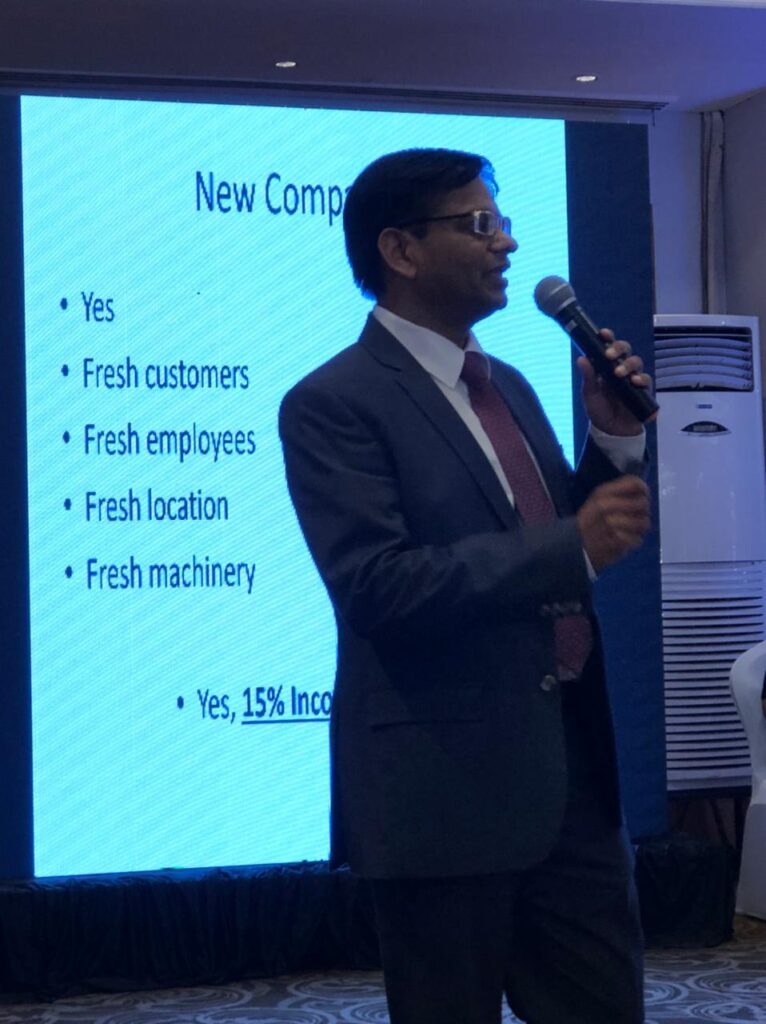
Indeed, staying updated with the latest fiscal policies is the cornerstone of a successful manufacturing business. On March 24, 2022, during a high-impact seminar organized by IamSMEofIndia, I had the privilege of sharing strategic ideas on Taxation and Finance tailored specifically for the Indian MSME sector.
Initially, many manufacturers overlook the significant savings available through Section 80JJAA of the Income Tax Act. Specifically, this section provides a deduction of 30% of additional employee cost for three years.
Key takeaway: If you are a manufacturing MSME hiring new staff, this incentive can substantially reduce your tax liability. Admittedly, proper documentation of the “additional employee” status is critical to claim this benefit successfully.
Furthermore, for those looking to expand or start a “Make in India” initiative, the tax landscape has never been more favorable. Notably, new manufacturing companies incorporated on or after October 1, 2019, can opt for a significantly lower base tax rate (15% plus surcharge and cess).
By choosing the right corporate structure, MSMEs can:
Lower Tax Outgo: Retain more profits for reinvestment into machinery and technology.
Global Competitiveness: Align with global tax standards to attract international partners.
Financial Discipline: Transition toward a system-driven management model.
Ultimately, the goal of our session was to align local manufacturing strengths with national objectives. In partnership with MSME-DI (Micro, Small & Medium Enterprises Development Institute), we discussed how financial discipline and strategic tax planning act as the digital engine for growth.
Proudly, as a member of IamSMEofIndia, we continue to provide a platform where small and medium enterprises can learn, network, and grow 10x by adopting top-notch financial technologies.
To conclude, the ideas shared in these 45 minutes are designed to be actionable. Whether you are a seasoned manufacturer or a new startup, the path to profitability is paved with better financial governance. Indeed, as the landscape of Indian manufacturing evolves, staying compliant and informed is no longer a choice—it is a competitive advantage.





Ready to Make Your Packaging Unit Sustainable & Systematic?
You run a private sector company. + Your staff does not get any pension, after they retire…..
💐
Many Clients of Finsys have already started this Innovative Scheme of Govt of India, and getting good tax benefits for self and other staff.

One can save tax in three ways via NPS. First, NPS investments are eligible for deduction under Section 80C. ( LIC, School Fee, Housing Loan instalment etc)

If one has already exhausted the Rs 1.5 lakh ceiling under Section 80C, one can claim an additional deduction of up to Rs 50,000 under Section 80CCD(1b). Lastly, up to 10% of the basic salary put in the NPS can be claimed as deduction under Section 80CCD(2).
Even, those very close to retirement, can claim more tax benefits if their company offers the NPS benefit. Under Section 80CCD(2), up to 10% of the basic salary put in the NPS by the company on behalf of the employee is tax free.
Point to note: The entire amount withdrawn will not be tax free. Though there is no reference to this in the tax laws, one can reasonably assume that 60% of the withdrawn amount will be tax free while the balance 40% will be taxed at the normal rate.
 This is actually an intelligent, simple and user friendly deferment of tax
 Note : By that time the tax exemption limits might have reached Rs 20 lakh or maybe Rs 30 lakhs…. and all your NPS pension money might be tax free after all Section 80CCD(2) NPS Tax Benefits 2026
https://enps.nsdl.com/eNPS/NationalPensionSystem.html
NPS Trust welcomes you to ‘eNPS’ ,which will facilitate:- Section 80CCD(2) NPS Tax Benefits 2026
➤ Opening of Individual Pension Account under NPS (only Tier I / Tier I & Tier II) by All Indian Citizens (including NRIs) between 18 – 70 years
➤ Making initial and subsequent contribution to your Tier I as well as Tier II account
For Account opening, you need to:
✔ Have Mobile number, email ID and an active Bank account with net Banking facility enabled
✔ In case, an applicant selects to open the individual pension account with PAN, the activation of
the PRAN is subject to KYC verification by the empanelled POP (name and address should
match with POP record) selected by applicant during the registration process.
To view the list of empanelled POP, Click Here
✔ Fill up all the mandatory details online
✔ Click Here for guidelines on filling details if Applicant residence for tax purposes in jurisdiction (s)
outside India
✔ Scan and upload your photograph (optional for Aadhaar) and signature
✔ Make online payment (Minimum amount of ₹ 500)
✔ Subscriber will have an option to authenticate form through OTP Authentication or eSign process

Some Extracts from the Sites of some banks offering the same : ( MLG has no allegiance with any of them )




UBI Website link :
https://www.unionbankofindia.co.in/english/nationalpensionsystem
|

https://www.hdfcbank.com/personal/invest/nps-national-pension-system
National Pension System (NPS) is a retirement benefit Scheme introduced by the Government of India to facilitate a regular income post retirement to all the subscribers. PFRDA (Pension Fund Regulatory and Development Authority) is the governing body for NPS.
National Pension System (NPS) is based on unique Permanent Retirement Account Number (PRAN) which is allotted to every subscriber. In order to encourage savings, the Government of India has made the scheme reassuring from security point of view and has offered some attractive benefits for. NPS account holders.
An NPS Account offers the following benefits:
| Tax benefits for Salaried Individual | Tax Benefits for Self Employed Individual |
| You can claim tax exemption upto Rs. 50,000 under section 80CCD (1B). This benefit is over an above limit of Rs. 1,50,000 under section 80C. | You can claim tax exemption upto Rs. 50,000 under section 80CCD (1B). This benefit is over an above limit of Rs. 1,50,000 under section 80C. |
| You may invest upto 10% of your basic salary + dearness allowance and claim tax exemption on the invested amount under section 80CCD(1). This tax exemption is subject to a limit of Rs. 1,50,000 under section 80C of Income Tax Act, 1961. | You may invest upto 20% of your gross annual income and claim tax exemption on the invested amount under section 80CCD(1). This tax exemption is subject to a limit of Rs. 1,50,000 under section 80C of Income Tax Act, 1961. |
*Employer contribution benefit is capped upto 7.5 lakhs for NPS, PF & Superannuation

https://sbi.co.in/web/personal-banking/investments-deposits/govt-schemes/nps
National Pension System (NPS) is a defined contribution pension system introduced by the Government of India as a part of Pension Sector reforms, with an objective to provide social security to all citizens of India. It is administered and regulated by PFRDA. Section 80CCD(2) NPS Tax Benefits 2026
This is one of the rare Deductions that is available in the “New Regime of Income tax also“…
Employer Share can get Income tax deduction u/s 80CCD(2)
Digital Transformation: Contact Finsys Experts Today
© 1992-2026 Finsys ERP . All Rights Reserved.